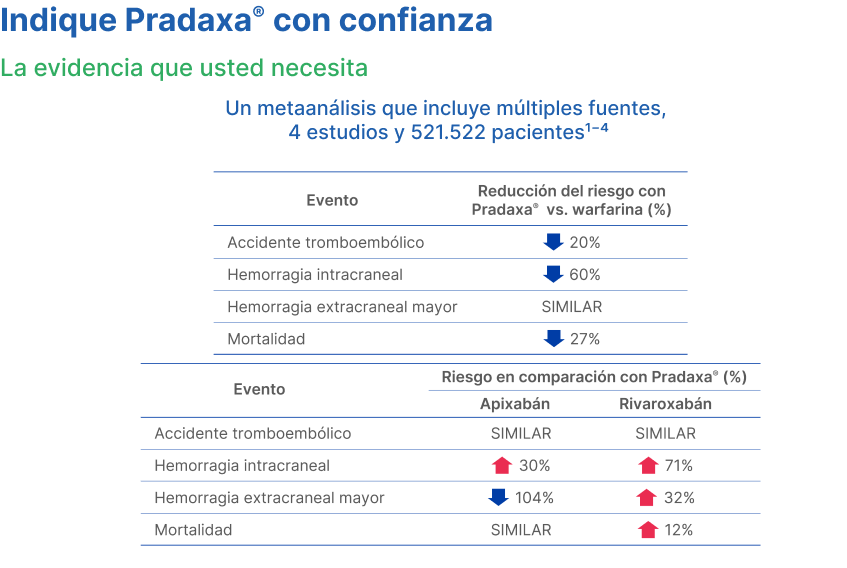


Inicio Beneficio consistente vs. warfarina: estudio RE-LY® Registro GARFIELD-AF Evidencia para indicar Pradaxa® vs. warfarina, apixabán y rivaroxabán Seguridad confirmada de Pradaxa® vs. warfarina, apixabán y rivaroxabán Evidencia de la eficacia de Pradaxa® en estudios clínicos y el mundo real Seguridad de Pradaxa® vs. otros ACOD (hemorragia mayor con apixabán y warfarina) Diferentes pacientes, diferentes historias ¿Quiénes podrían requerir reversión de ACOD en Chile? Ventaja de contar con un agente reversor Ventajas de Pradaxa® sobre otros ACOD Estudio RE-VERSE AD - Reversión de Pradaxa® Pacientes con FA y riesgo de ACV en Chile, en quienes puede indicarse Pradaxa® Pacientes con ACV en Chile Reducción del riesgo de ACV con Pradaxa® vs. warfarina ¿En qué casos es realmente necesario revertir la anticoagulación oral? ¿Quiénes no requieren reversión de ACOD? ¿Quiénes pueden beneficiarse con Pradaxa® al contar con un agente reversor específico?

Referencia:

  1. Gorst-Rasmussen A, Lip GY, Bjerregaard Larsen T. Rivaroxaban versus warfarin and dabigatran in atrial fibrillation: comparative effectiveness and safety in Danish routine care. Pharmacoepidemiol Drug Saf. 2016;25(11):1236-1244.
  2. Lip GY, Keshishian A, Kamble S, et al. Real-world comparison of major bleeding risk among non-valvular atrial fibrillation patients initiated on apixaban, dabigatran, rivaroxaban, or warfarin. A propensity score matched analysis. Thromb Haemost. 2016;116(5):975-986.
  3. Graham DJ, Baro E, Zhang R, et al. Comparative stroke, bleeding, and mortality risks in older Medicare patients treated with oral anticoagulants for nonvalvular atrial fibrillation. Am J Med. 2019;132(5):596-604.
  4. Mazurek M, Teutsch C, Diener HC, et al. Safety and effectiveness of dabigatran at 2 years: final outcomes from phase II of the GLORIA-AF registry program. Am Heart J. 2019;218:123-127.